
Contents
Overview
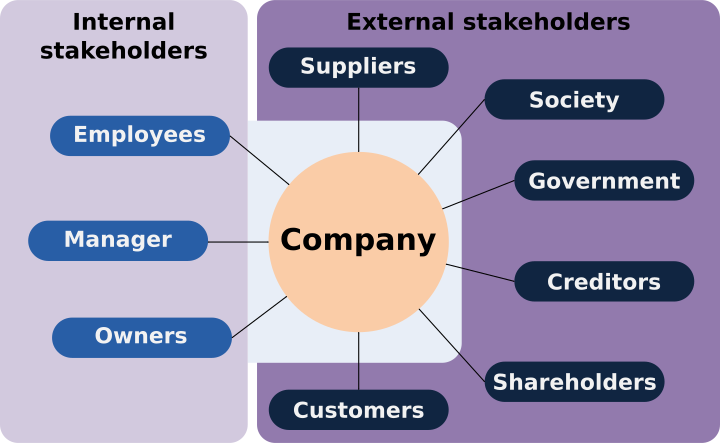
Shareholder capitalism is an economic ideology asserting that the ultimate purpose of a corporation is to generate wealth for its owners, the shareholders. This perspective posits that by focusing on profit maximization, companies indirectly benefit society through job creation, innovation, and efficient allocation of resources. It contrasts sharply with stakeholder capitalism, which argues for a broader responsibility to all parties affected by a company's operations, including employees, customers, suppliers, and the environment. The dominance of shareholder capitalism in the late 20th and early 21st centuries has been linked to increased corporate profitability and stock market growth, but also to rising income inequality, short-termism in business strategy, and environmental concerns. The debate over its efficacy and ethical implications remains a central tension in modern economic discourse.
🎵 Origins & History
The intellectual roots of shareholder capitalism can be traced back to classical economic thought, particularly the writings of Adam Smith. This perspective gained significant traction in the latter half of the 20th century, especially following the rise of institutional investors and the increasing financialization of economies.
⚙️ How It Works
Under shareholder capitalism, the primary mechanism for corporate governance is the board of directors, elected by shareholders to oversee management. Management's performance is evaluated predominantly on financial metrics, such as earnings per share (EPS), return on equity (ROE), and stock price appreciation. Executive compensation is often heavily tied to these metrics, creating strong incentives to prioritize shareholder value. Decisions regarding investment, expansion, and even employee welfare are typically filtered through the lens of their potential impact on profitability and shareholder returns. This model assumes that the pursuit of profit is the most efficient way to allocate capital and drive innovation, ultimately leading to broader economic prosperity.
📊 Key Facts & Numbers
The era of shareholder capitalism has coincided with significant economic shifts. This focus on shareholder returns has been linked to a decline in corporate investment in research and development as a percentage of revenue for many large firms, and a significant increase in corporate debt. The market capitalization of global equities has surged, reflecting the immense wealth generated under this system.
👥 Key People & Organizations
Key figures who have shaped or defended shareholder capitalism include economist Michael Jensen, whose work on agency theory in the 1970s provided a theoretical framework for aligning management interests with shareholder interests, often through performance-based pay and stock options. Prominent business leaders like Jack Welch, former CEO of General Electric, became vocal proponents. Investment firms such as BlackRock and Vanguard Group, as massive holders of equity across numerous companies, wield significant influence and often engage with corporate management on behalf of their investor clients, frequently pushing for enhanced shareholder value. The Business Roundtable, an association of CEOs of major U.S. companies, also historically championed this view.
🌍 Cultural Impact & Influence
Shareholder capitalism has profoundly influenced global culture, shaping expectations around corporate behavior and individual wealth creation. It fueled the rise of the "shareholder value revolution" in the 1980s. This ideology permeated business schools, executive training programs, and financial media, creating a generation of leaders and investors who viewed profit maximization as the ultimate corporate virtue. The ubiquitous presence of stock market tickers, the popularity of financial news channels like CNBC, and the widespread adoption of stock options as employee compensation are all cultural artifacts of this dominant economic paradigm. It has also contributed to a societal narrative where individual financial success is often equated with societal contribution.
⚡ Current State & Latest Developments
In recent years, there's been a noticeable, albeit contested, shift away from pure shareholder primacy. Companies like Patagonia, under founder Yvon Chouinard, have experimented with new ownership structures, such as transferring ownership to a trust and a non-profit organization to prioritize environmental and social goals over profit maximization. Activist investors, while often pushing for shareholder returns, are increasingly vocal about environmental, social, and governance (ESG) factors, forcing companies to address broader concerns. The ongoing debate about the sustainability and equity of the current economic model continues to drive discussions about alternative frameworks.
🤔 Controversies & Debates
The most significant controversy surrounding shareholder capitalism is its perceived tendency to exacerbate income inequality and foster short-term financial thinking at the expense of long-term sustainability and social well-being. Critics argue that the relentless pursuit of profit can lead to practices like mass layoffs, wage stagnation, environmental degradation, and a neglect of community needs, as companies prioritize cost-cutting and revenue generation above all else. Conversely, proponents argue that shareholder capitalism is the most efficient engine for wealth creation, driving innovation and providing goods and services that benefit society, and that any negative externalities are best addressed through targeted government regulation rather than by altering the fundamental corporate purpose.
🔮 Future Outlook & Predictions
The future of shareholder capitalism is uncertain, with growing pressure for a more stakeholder-oriented approach. We may see a hybrid model emerge, where companies are legally and culturally compelled to balance shareholder returns with broader stakeholder interests. Innovations in corporate governance, such as Benefit Corporations and new forms of cooperative ownership, could gain further traction. The increasing influence of ESG investing and the growing awareness of climate change and social justice issues suggest that companies will face mounting pressure to demonstrate value beyond pure profit. Predictions range from a continued, albeit moderated, dominance of shareholder focus to a more radical restructuring of corporate purpose and ownership models, potentially driven by regulatory changes or shifts in consumer and investor preferences.
💡 Practical Applications
Shareholder capitalism is not merely an abstract economic theory; it's embedded in the operational DNA of countless corporations. Its practical application is evident in how public companies are structured, managed, and evaluated. For instance, the decision to invest in new technology, enter new markets, or even acquire another company is almost invariably framed by its projected impact on shareholder value. The widespread use of stock options and performance shares for executive compensation is a direct manifestation of this principle, aiming to align managerial incentives with those of the owners.
Key Facts
- Category
- philosophy
- Type
- topic