
Contents
Overview
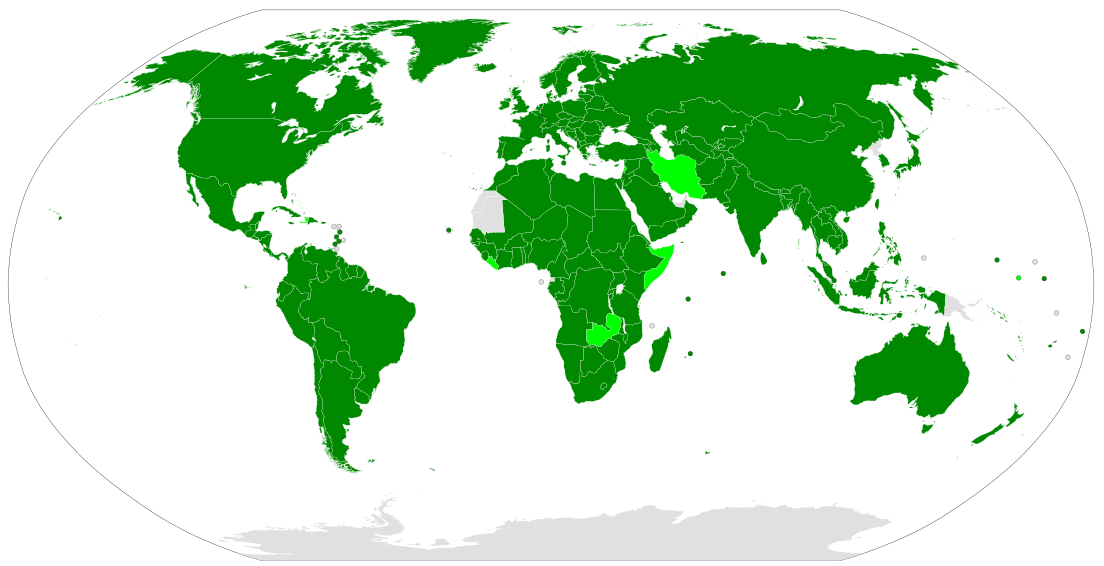
The formal recognition of children's rights in armed conflict emerged from a growing global awareness of the disproportionate suffering inflicted upon young populations during wartime. While historical accounts abound with instances of child combatants and civilian casualties, the modern movement gained momentum in the late 20th century, spurred by the work of organizations like Human Rights Watch and the United Nations. The Convention on the Rights of the Child (CRC) laid crucial groundwork by establishing a universal standard for the treatment of children. Building on this, the Optional Protocol to the CRC on the Involvement of Children in Armed Conflict (OPAC) was adopted, specifically addressing the recruitment and use of children in hostilities. This protocol, often referred to as the 'child soldier treaty,' marked a significant legal milestone in the fight to protect children from the direct and indirect consequences of armed conflict.
⚙️ How It Works
The legal framework for children's rights in armed conflict operates through a multi-layered system of international treaties, customary international law, and national legislation. The OPAC is central, obligating state parties to prohibit the recruitment of individuals under 18 into their armed forces and to prevent those aged 16 or 17 from taking direct part in hostilities. It also extends prohibitions to non-state armed groups, forbidding them from recruiting anyone under 18 for any purpose. Beyond OPAC, the Geneva Conventions provide overarching protections for civilians, including children, in times of conflict. Enforcement relies on a combination of state accountability, international criminal justice mechanisms like the International Criminal Court, and the advocacy efforts of numerous NGOs that monitor violations and push for compliance.
📊 Key Facts & Numbers
The scale of the problem is staggering, with figures remaining alarmingly high. In 2023, the UNICEF reported that over 468 million children were living in conflict zones worldwide, a record high. These children face extreme risks, including death, injury, sexual violence, and psychological trauma. The economic cost is also immense, with reconstruction and recovery efforts in post-conflict settings often requiring billions of dollars, a significant portion of which should be allocated to child protection and reintegration programs.
👥 Key People & Organizations
Numerous individuals and organizations have been instrumental in advancing children's rights in armed conflict. Graça Machel's seminal 1996 report, 'The Impact of Armed Conflict on Children,' brought unprecedented global attention to the issue, leading to the establishment of the UN Secretary-General's Special Representative on Children and Armed Conflict. Olara Otunnu, a former Under-Secretary-General for Children and Armed Conflict, was a prominent advocate, tirelessly campaigning for the rights of child soldiers. Key organizations like Save the Children, Amnesty International, and the International Committee of the Red Cross (ICRC) consistently document abuses, provide aid, and lobby governments. The Coalition to Stop the Use of Child Soldiers (now part of Watch This Space) played a vital role in advocating for the OPAC treaty.
🌍 Cultural Impact & Influence
The global discourse on children's rights in armed conflict has profoundly shaped international humanitarian law and public consciousness. The image of the child soldier, once largely ignored, is now a potent symbol of wartime atrocity, influencing media narratives, artistic expressions, and public campaigns. This increased visibility has pressured governments and armed groups to adopt policies against child recruitment, though implementation remains inconsistent. The movement has also fostered a generation of activists and policymakers dedicated to child protection, influencing development aid priorities and post-conflict reconstruction strategies. Furthermore, it has contributed to the broader understanding of human rights as indivisible and universally applicable, even in the most challenging circumstances.
⚡ Current State & Latest Developments
Despite the legal protections in place, the reality for millions of children remains dire. The UN Security Council regularly addresses the issue through its Working Group on Children and Armed Conflict, but enforcement mechanisms often fall short. Emerging threats, such as the use of drones and cyber warfare, present new challenges for protecting children. Moreover, the increasing complexity of non-state armed groups and the blurring lines between combatants and civilians complicate efforts to identify and protect vulnerable children. The ongoing displacement crisis, with millions of children forced from their homes, exacerbates their vulnerability to trafficking and exploitation.
🤔 Controversies & Debates
A central controversy revolves around the age of military recruitment. While OPAC prohibits conscription below 18, some states maintain voluntary recruitment ages of 16 or 17. Critics argue this is a loophole that still exposes young people to the dangers of war, while proponents contend it respects national sovereignty and offers structured opportunities. Another debate concerns the accountability of non-state armed groups, which often operate outside established legal frameworks, making prosecution for child recruitment difficult. The effectiveness of disarmament, demobilization, and reintegration (DDR) programs for former child soldiers is also debated, with concerns about insufficient funding, long-term support, and the psychological reintegration of children who have committed grave acts.
🔮 Future Outlook & Predictions
The future outlook for children's rights in armed conflict hinges on strengthening enforcement mechanisms and adapting to evolving warfare. Experts predict a continued focus on holding perpetrators accountable through international and national courts, potentially expanding the scope of war crimes to include systematic child recruitment. There's a growing emphasis on preventative measures, including robust educational programs in conflict-prone regions and early warning systems to identify potential recruitment hotspots. The role of technology in both perpetrating and preventing harm to children in conflict will likely intensify, requiring innovative legal and policy responses. Furthermore, sustained political will and increased financial investment in child protection and DDR programs are crucial for long-term success, aiming to reduce the number of children affected by conflict from the current 468 million to zero.
💡 Practical Applications
The principles of protecting children in armed conflict have practical applications across various domains. International humanitarian organizations like UNICEF and WFP implement programs for displaced children, providing education, healthcare, and psychosocial support in war-torn areas. Military forces in some countries have adopted codes of conduct and training modules that incorporate international humanitarian law concerning children. Legal professionals and human r
Key Facts
- Category
- movements
- Type
- topic