
Contents
- 🎵 Origins & History
- ⚙️ How It Works
- 📊 Key Facts & Numbers
- 👥 Key People & Organizations
- 🌍 Cultural Impact & Influence
- ⚡ Current State & Latest Developments
- 🤔 Controversies & Debates
- 🔮 Future Outlook & Predictions
- 💡 Practical Applications
- 📚 Related Topics & Deeper Reading
- Frequently Asked Questions
- References
- Related Topics
Overview
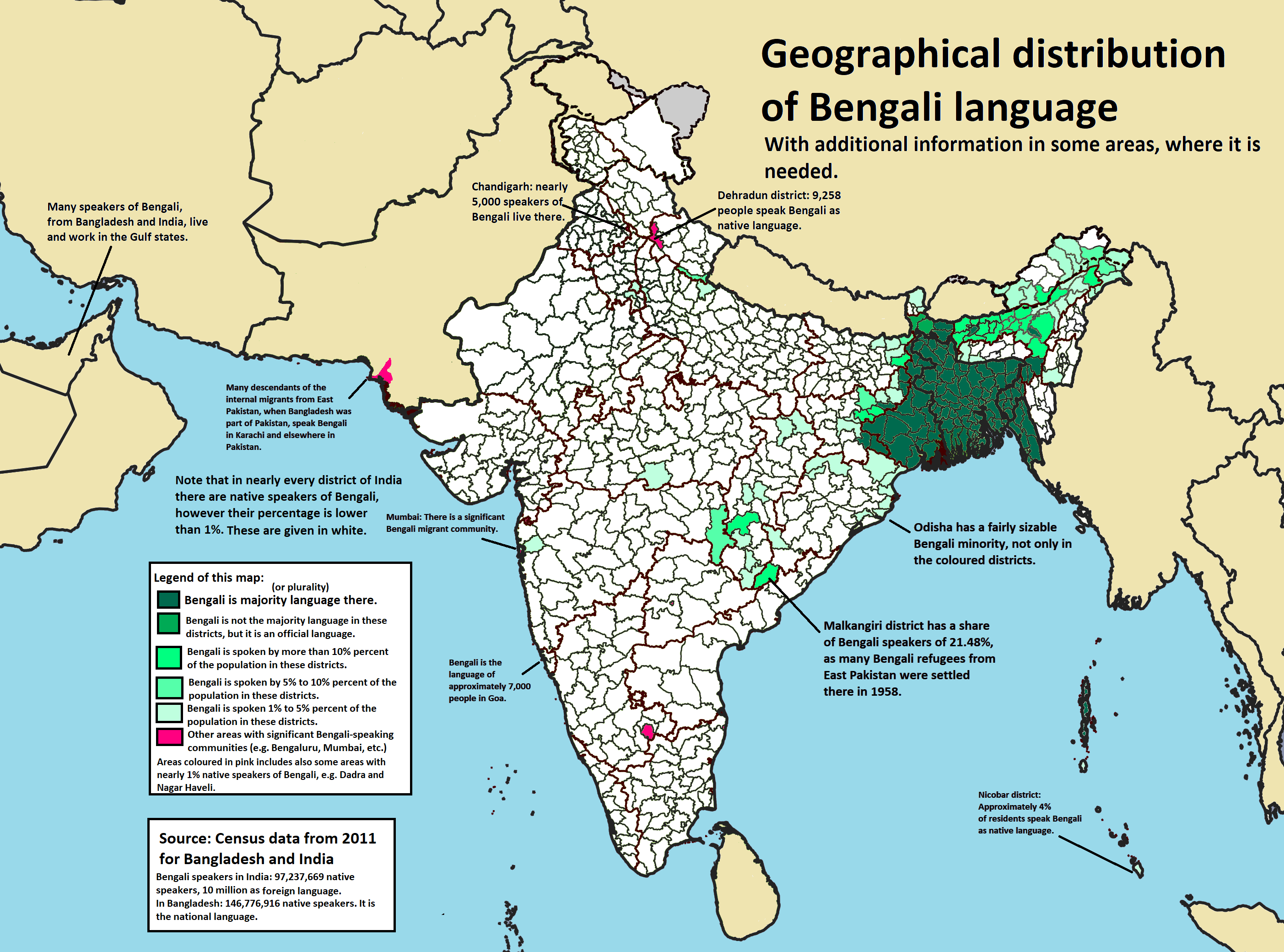
Bengali, or Bangla, is a classical Indo-Aryan language spoken by over 242 million native speakers and an additional 43 million as a second language, making it the sixth most spoken native language globally. It is the official and national language of Bangladesh, where 98% of the population uses it as their first language, and holds significant official status in India's West Bengal, Tripura, and parts of Assam and Jharkhand. Originating from the Indo-Iranian branch of the Indo-European language family, Bengali boasts a vibrant literary tradition, famously represented by Nobel laureate Rabindranath Tagore, and continues to evolve with modern media and digital platforms. Its script, derived from Brahmi, is unique and visually distinct, contributing to its cultural identity. The language's influence extends beyond its primary regions, with diaspora communities actively preserving and promoting it worldwide.
🎵 Origins & History
The genesis of the Bengali language can be traced back to the ancient Indo-Aryan languages, with its direct ancestor being Sanskrit. Emerging from Magadhi Prakrit and later Apabhraṃśa, Old Bengali began to take shape around the 10th century CE. Early literary evidence, such as the Charyapada, a collection of Buddhist mystic songs dating between the 8th and 12th centuries, showcases the nascent form of the language. Over centuries, it evolved through distinct phases: Old Bengali (900–1300 CE), Middle Bengali (1300–1800 CE), and finally Modern Bengali, which solidified in the 19th century under the influence of reformers and writers like Ishwar Chandra Vidyasagar and Bankim Chandra Chattopadhyay. The standardization process was significantly propelled by the establishment of Calcutta University in 1857 and the subsequent literary renaissance.
⚙️ How It Works
Bengali is an Indo-Aryan language characterized by its Subject-Object-Verb (SOV) sentence structure, though variations exist for emphasis. It is an agglutinative language, meaning grammatical functions are often expressed by adding suffixes to root words, creating complex word forms. The Bengali script, known as Bangla Lipi, is an abugida derived from the Brahmi script and is written from left to right. It features a distinctive vowel-carrying horizontal line, or 'matra', above the main characters. Bengali has a rich system of verb conjugations that indicate tense, aspect, mood, and person, and its noun system includes grammatical gender and number, though case marking is less prominent than in some other Indo-Aryan languages. The language also utilizes a system of honorifics and politeness levels, reflecting social hierarchies.
📊 Key Facts & Numbers
As of 2025, Bengali is spoken by over 242 million native speakers and an additional 43 million second-language speakers, ranking it as the sixth most spoken native language and seventh most spoken language overall worldwide. In Bangladesh, it is the first language for approximately 98% of its 170 million population. In India, Bengali is the second most spoken language, with over 97 million speakers, primarily concentrated in West Bengal (over 80% of the population), Tripura (over 50%), and Assam's Barak Valley. The Jharkhand state officially recognized Bengali as its second language in 2011, adding another 1.4 million speakers. The global Bengali diaspora numbers in the millions, with significant communities in the United Kingdom, United States, and the Middle East.
👥 Key People & Organizations
The literary landscape of Bengali is dominated by Rabindranath Tagore, the first non-European Nobel laureate in Literature (1913) for his collection of poems 'Gitanjali'. Other pivotal figures include Bankim Chandra Chattopadhyay, author of the nationalistic novel 'Anandamath' and the song 'Vande Mataram'; Sarat Chandra Chattopadhyay, known for his social commentary novels; and Satyajit Ray, a globally acclaimed filmmaker whose works often explored Bengali culture and society. Organizations like the Bangla Academy in Bangladesh and the Paschimbanga Bangla Akademi in West Bengal play crucial roles in promoting and standardizing the language and its literature. The University of Dhaka and University of Calcutta are key academic institutions for Bengali studies.
🌍 Cultural Impact & Influence
Bengali literature is one of the oldest and most vibrant literary traditions in South Asia, encompassing poetry, novels, short stories, and drama. The language has been a powerful vehicle for national identity, particularly in the Bangladesh Liberation War of 1971, where the Bengali Language Movement of 1952 was a precursor to the broader struggle for independence. Bengali cinema, particularly the works of Satyajit Ray, has achieved international acclaim, showcasing Bengali culture and storytelling to a global audience. The language's influence is also evident in music, with artists like Lata Mangeshkar and Kishore Kumar having sung numerous Bengali songs, and in the widespread popularity of Bengali cuisine and festivals like Pohela Boishakh.
⚡ Current State & Latest Developments
In the digital age, Bengali is increasingly present online. Initiatives like Google Translate offer Bengali language support, and numerous websites, blogs, and social media platforms are dedicated to Bengali content. The development of Bengali computing and typing tools, such as Avro Keyboard, has made digital communication more accessible. Despite the dominance of English in global technology, Bengali is seeing growth in digital media consumption, with a rising number of Bengali-language news outlets and entertainment channels available online. The language is also being integrated into artificial intelligence research, with efforts to improve natural language processing capabilities for Bengali.
🤔 Controversies & Debates
One significant debate revolves around the standardization of Bengali, particularly concerning regional dialects and the influence of Kolkata's dialect versus that of Dhaka. While the literary standard is largely understood across regions, variations in pronunciation and vocabulary persist. Another point of contention is the perceived influence of English words (Banglish) on modern Bengali, with some lamenting the dilution of the pure language while others see it as natural linguistic evolution. The historical debate over the script's orthography, particularly the simplification of certain conjunct consonants, also resurfaces periodically among linguists and writers.
🔮 Future Outlook & Predictions
The future of Bengali appears robust, driven by its large and growing speaker base in both Bangladesh and India. Increased digital literacy and online content creation are expected to further solidify its presence in the digital sphere. Efforts to preserve and promote regional dialects and classical literature will likely continue, ensuring the language's rich diversity is maintained. As artificial intelligence capabilities for Bengali improve, its utility in fields like machine translation and voice assistants will expand. Furthermore, the global diaspora's continued engagement with the language promises to foster its international reach and cultural exchange.
💡 Practical Applications
Bengali serves as the primary medium of instruction in educational institutions across Bangladesh and West Bengal, from primary schools to universities like Dhaka University and Jadavpur University. It is extensively used in media, including television, radio, and print journalism, with major outlets like Prothom Alo and The Daily Star publishing in Bengali. Bengali literature is a significant academic field, studied globally. In business, while English often dominates in multinational corporations, Bengali is crucial for local market engagement and customer service in Bangladesh and West Bengal. Digital applications include Bengali language keyboards, translation tools, and content creation platforms.
Key Facts
- Year
- c. 10th century CE (Old Bengali)
- Origin
- Bengal region (present-day Bangladesh and Indian states of West Bengal, Tripura, Assam)
- Category
- culture
- Type
- concept
Frequently Asked Questions
What is the Bengali language and where is it spoken?
Bengali, also known as Bangla, is a classical Indo-Aryan language spoken primarily by the Bengali people. It is the official language of Bangladesh and is also widely spoken in the Indian states of West Bengal, Tripura, and parts of Assam and Jharkhand. As of 2025, it ranks as the sixth most spoken native language globally, with over 242 million native speakers and an additional 43 million second-language speakers.
What is the history and origin of the Bengali language?
Bengali evolved from Sanskrit through Magadhi Prakrit and Apabhraṃśa. Its earliest literary form, Old Bengali, can be traced back to around the 10th century CE, with notable early works like the Charyapada. The language underwent significant development through the Middle Bengali period, culminating in the standardization of Modern Bengali in the 19th century, heavily influenced by prominent writers and educational institutions like Calcutta University.
Who are the most famous figures associated with Bengali language and literature?
The most celebrated figure is Rabindranath Tagore, the first non-European Nobel laureate in Literature, whose poetry and prose are seminal to Bengali literature. Other influential writers include Bankim Chandra Chattopadhyay, author of the patriotic novel 'Anandamath', and Satyajit Ray, a world-renowned filmmaker whose cinematic works deeply explored Bengali culture. Ishwar Chandra Vidyasagar was instrumental in shaping modern Bengali prose.
What are the key characteristics of the Bengali script and grammar?
The Bengali script, or Bangla Lipi, is an abugida derived from the Brahmi script, written left-to-right with a distinctive horizontal line (matra) above characters. Grammatically, Bengali is an agglutinative language with a Subject-Object-Verb (SOV) sentence structure. It features verb conjugations for tense, aspect, and person, and uses suffixes to modify word meanings, creating complex word forms.
How is Bengali used in modern times, especially in technology and media?
Bengali is extensively used in media, education, and business across Bangladesh and West Bengal. Digital platforms are increasingly supporting the language, with tools like Avro Keyboard and Google Translate facilitating online communication. Bengali content is growing on websites, social media, and streaming services, and advancements in artificial intelligence are enhancing its capabilities in areas like natural language processing and voice assistants.
What are some controversies or debates surrounding the Bengali language?
Debates often center on the standardization of Bengali, particularly the differences between regional dialects and the influence of foreign words, especially English (termed 'Banglish'). There are also ongoing discussions regarding orthographic reforms and the simplification of certain conjunct consonants in the Bengali script. The historical Bengali Language Movement itself was a significant political and social debate.
What is the global reach and future outlook for the Bengali language?
With over 285 million total speakers, Bengali has a substantial global presence, bolstered by diaspora communities worldwide. Its future appears strong, driven by population growth in Bangladesh and India, and increasing digital engagement. Continued efforts in literature, media, and technology are expected to ensure its vitality and cultural relevance for generations to come.